




¡Nuestro equipo cuenta con más de 7,000,000 operadores!
Cada día, trabajamos juntos para mejorar las operaciones. Obtenemos grandes resultados y seguimos adelante.
El reconocimiento de millones de operadores en todo el mundo es el mejor agradecimiento a nuestro trabajo! ¡Usted hizo su elección y haremos todo lo que esté a nuestro alcance para satisfacer sus expectativas!
¡Juntos somos un gran equipo!
InstaSpot. ¡Orgulloso de trabajar para usted!





¡Actor, 6 veces ganador del torneo UFC y un verdadero héroe!
El hombre que se hizo a sí mismo. El hombre que sigue nuestro camino.
El secreto detrás del éxito de Taktarov es el constante movimiento hacia el objetivo.
¡Revele todo los lados de su talento!
Descubra, intente, fracase, ¡pero nunca se rinda!
InstaSpot. ¡Su historia de éxito comienza aquí!
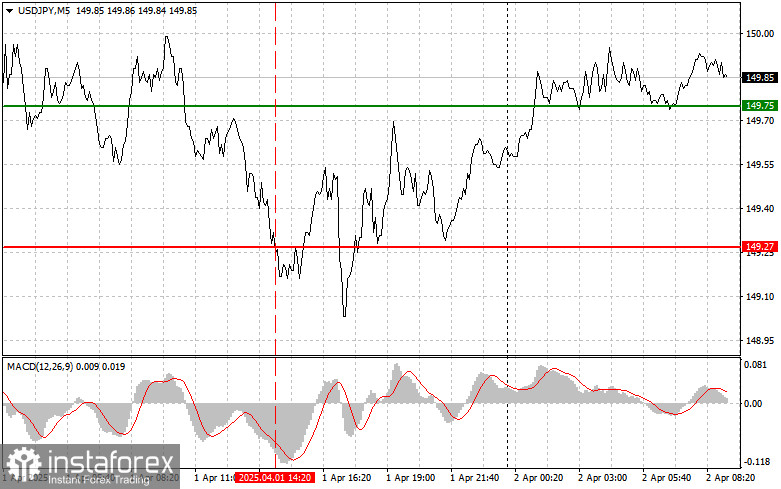
The price test at 149.27 occurred when the MACD indicator had already moved significantly below the zero line, which limited the pair's downside potential. For this reason, I did not sell the dollar. Throughout the day, I did not encounter any other suitable entry points.
Weak U.S. Manufacturing PMI data put pressure on the dollar and helped the Japanese yen strengthen. The PMI index, which reflects business activity in the manufacturing sector, came in below analysts' expectations, raising concerns about the outlook for U.S. economic growth. This, in turn, reduced the dollar's appeal. The yen, traditionally considered a safe-haven currency, benefited from the situation. Additional support for the yen comes from expectations of a possible shift in the Bank of Japan's monetary policy.
Today's relatively weak report on Japan's monetary base had little impact on the yen's exchange rate against the dollar. However, that does not mean the country's economy is stable. Many economists note a slowdown in growth, which could trigger more market volatility. Still, short-term fluctuations in the yen may be tied to global factors, such as changes in U.S. trade policy toward several developed nations. We'll get more details later today, so be prepared for increased market volatility.
For intraday strategy, I will focus primarily on implementing Scenarios #1 and #2.
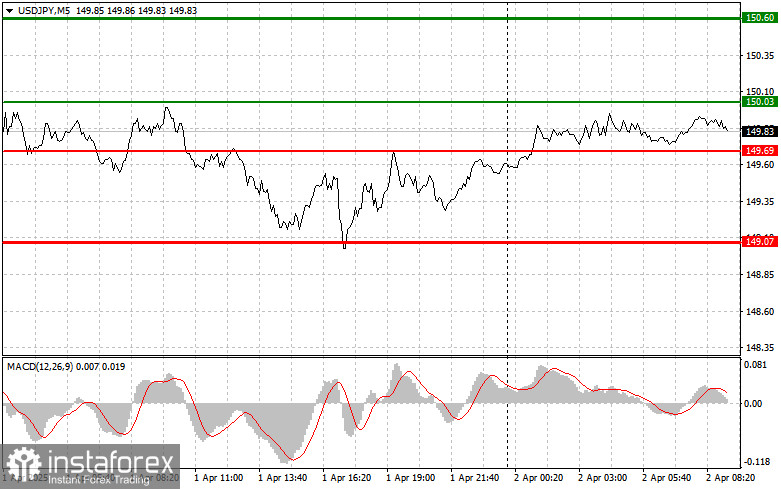
Scenario #1: I plan to buy USD/JPY today upon reaching the entry point around 150.03 (green line on the chart), targeting a rise to 150.60 (thicker green line). Near 150.60, I plan to exit long positions and open short positions in the opposite direction (expecting a 30–35 pip reversal). The best time to buy the pair is during pullbacks or significant dips. Important: Before buying, ensure the MACD indicator is above the zero line and beginning to rise.
Scenario #2: I also plan to buy USD/JPY if the price tests the 149.69 level twice in a row while the MACD is in oversold territory. This will limit the pair's downside and trigger a bullish reversal. A rise toward 150.03 and 150.60 can then be expected.
Scenario #1: I plan to sell USD/JPY only after breaking below 149.69 (red line on the chart), which could lead to a rapid decline. The key target for sellers will be 149.07, where I intend to exit short positions and open immediate longs (expecting a 20–25 pip bounce). Important: Before selling, ensure the MACD is below the zero line and starting to fall from it.
Scenario #2: I also plan to sell USD/JPY if the price tests 150.03 twice in a row, with the MACD in overbought territory. This will limit upside potential and lead to a bearish reversal. A decline toward 149.69 and 149.07 may follow.
*El análisis de mercado publicado aquí tiene la finalidad de incrementar su conocimiento, más no darle instrucciones para realizar una operación.
¡Los informes analíticos de InstaSpot lo mantendrá bien informado de las tendencias del mercado! Al ser un cliente de InstaSpot, se le proporciona una gran cantidad de servicios gratuitos para una operación eficiente.


